
How to Choose Overlay Welded Pipe for Your Project?
Choosing an Overlay Welded Pipe is a practical decision, not a simple price comparison. The correct pipe must resist abrasion, corrosion, heat, pressure, or several threats at once. A pipe may look excellent in a workshop and still fail beside a slurry pump. That uncomfortable gap deserves attention.
The World Steel Association reported 1.89 billion tonnes of global crude steel production in 2023. This scale shows the importance of efficient material use. However, steel volume does not equal service reliability. The International Energy Agency’s Oil 2024 report also highlights continuing investment in energy infrastructure and declining tolerance for unplanned downtime. These trends make surface engineering increasingly relevant. Overlay welding can extend service life, but only when the base pipe, overlay alloy, thickness, dilution, and inspection method match the operating conditions.
Dr. John C. Lippold, a recognized welding-metallurgy expert, has stated, “Weldability is not an intrinsic property; it depends on the process and application.” That principle should guide every specification. Buyers should review operating temperature, fluid chemistry, flow velocity, pressure cycles, and expected wear. They should also request procedure qualification records, hardness results, dimensional reports, and non-destructive testing evidence. Standards such as API 5L and ASME Section IX may support the evaluation, but they do not replace project-specific engineering judgment. No selection is perfect. A thicker overlay can increase protection, yet it may raise cost, residual stress, or dimensional problems. This article explains how to compare Overlay Welded Pipe options with evidence, realistic risk assessment, and a willingness to question convenient assumptions.
Define Overlay Welded Pipe and Its Industrial Purpose
How to Choose Overlay Welded Pipe for Your Project?
Define Overlay Welded Pipe and Its Industrial Purpose
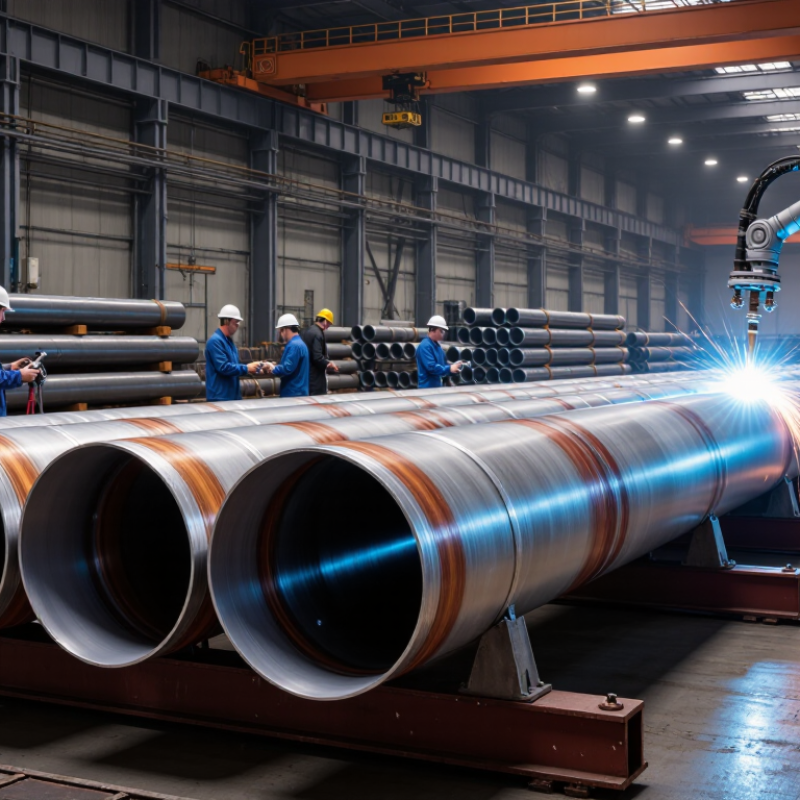
Overlay welded pipe is a steel pipe with a metallurgically bonded protective layer. The overlay is applied by welding a corrosion-resistant or wear-resistant alloy onto the pipe surface. Unlike paint or a loose sleeve, this layer becomes part of the pipe structure. It can protect the inner bore, outer surface, or selected connection areas.
Its industrial purpose is practical. It extends service life where ordinary steel faces corrosion, erosion, heat, or abrasive flow. Mining pipelines may carry slurry containing sharp mineral particles. Chemical plants may transport aggressive liquids through heated lines. Power facilities can use overlay pipe near boilers, ash systems, and high-temperature equipment. The correct alloy depends on the medium, temperature, pressure, and expected wear pattern.
Choose carefully.
Project engineers should review wall thickness, weld quality, hardness, and dimensional tolerances. A laboratory test can confirm chemical resistance, but field conditions may behave differently. We have seen designs fail when engineers considered corrosion but ignored particle impact at bends. That mistake is easy to repeat. Pipe sections should also match the welding procedure, inspection plan, and maintenance schedule. Visual inspection, ultrasonic testing, and documented material certificates improve reliability. Still, no overlay is perfect. Poor installation, unexpected chemistry, or excessive vibration can shorten its life. A realistic selection compares performance, repair access, and total operating cost rather than purchase price alone.
How to Choose Overlay Welded Pipe for Your Project? - Define Overlay Welded Pipe and Its Industrial Purpose
| Selection Dimension | What It Means | Typical Options or Values | Industrial Purpose | Project Selection Guidance |
|---|---|---|---|---|
| Definition | A pipe manufactured by welding a corrosion-, erosion-, abrasion-, or heat-resistant alloy layer onto the surface of a steel pipe or pipe component. | Carbon steel or low-alloy steel base pipe with a welded alloy overlay. | Combines the structural strength of the base pipe with the surface performance of the overlay material. | Use overlay pipe when the service environment is more aggressive than the base pipe can withstand economically. |
| Base Pipe Material | The structural pipe beneath the welded overlay. | Carbon steel, low-alloy steel, or other weldable pressure-containing steel. | Provides pressure resistance, mechanical strength, and dimensional support. | Select the base material according to design pressure, temperature, code requirements, and pipe size. |
| Overlay Alloy | The welded surface layer that contacts the process medium or abrasive material. | Stainless steel, nickel-based alloy, cobalt-based alloy, or iron-based hardfacing alloy. | Improves resistance to corrosion, pitting, erosion, abrasion, cavitation, or high-temperature wear. | Match the alloy chemistry to the actual fluid, solids content, temperature, pressure, and wear mechanism. |
| Overlay Thickness | The thickness of the deposited alloy layer after welding and finishing. | Common project specifications often range from approximately 2 to 6 mm, subject to design and wear allowance. | Determines the available service life before the protective layer is consumed. | Increase thickness for severe wear or corrosion only after considering dilution, distortion, machining allowance, and cost. |
| Welding Process | The process used to deposit the alloy onto the pipe surface. | Submerged arc welding, gas metal arc welding, gas tungsten arc welding, or other qualified overlay procedures. | Controls deposition rate, dilution, heat input, surface quality, and production consistency. | Choose a qualified procedure suitable for the alloy, pipe geometry, required thickness, and applicable fabrication code. |
| Corrosion Resistance | The ability of the overlay to resist chemical attack from the process environment. | Relevant factors include chlorides, acids, alkalis, moisture, hydrogen sulfide, and carbon dioxide. | Protects the internal or external pipe surface and reduces leakage and unplanned replacement. | Base the alloy choice on fluid composition, concentration, temperature, flow velocity, and exposure time. |
| Wear Resistance | The ability to withstand material loss caused by sliding, impact, or particle flow. | Abrasion-resistant iron-based overlays, carbide-containing deposits, or tougher ductile alloys. | Extends service life in slurry transport, mineral handling, ash handling, and bulk-material systems. | Identify whether wear is abrasive, impact-driven, erosive, or a combination before selecting hardness and toughness. |
| Operating Temperature | The minimum, normal, and maximum temperature experienced during operation, startup, and shutdown. | Specified by the process design; alloy performance varies significantly with temperature. | Ensures the overlay retains strength, corrosion resistance, and dimensional stability in service. | Check high-temperature strength, thermal expansion, thermal cycling, and compatibility between overlay and base pipe. |
| Pipe Dimensions | Outside diameter, wall thickness, length, roundness, and connection geometry. | Project-specific dimensions based on flow capacity, pressure design, installation, and applicable standards. | Determines hydraulic performance, fit-up, weight, support requirements, and installation compatibility. | Confirm dimensional tolerances after welding, machining, bending, coating, and any required end preparation. |
| Bond and Dilution Control | Bond quality describes attachment to the base metal; dilution is the mixing of base metal into the overlay weld metal. | Controlled through qualified welding parameters, layer count, heat input, and procedure qualification. | Maintains overlay chemistry, adhesion, integrity, and resistance properties. | Require inspection and acceptance criteria for cracks, porosity, lack of fusion, hardness, and chemical composition where applicable. |
| Inspection and Testing | Verification that the finished pipe meets design, fabrication, and service requirements. | Visual inspection, dimensional checks, liquid penetrant testing, ultrasonic testing, hardness testing, chemical analysis, and pressure testing when specified. | Detects surface defects, bonding problems, excessive dilution, dimensional deviations, and pressure-boundary issues. | Define inspection scope in the purchase specification and align it with the governing construction code. |
| Typical Industrial Applications | Industries and systems exposed to aggressive chemicals, abrasive solids, erosion, or elevated temperatures. | Oil and gas, chemical processing, power generation, mining, cement, pulp and paper, and waste treatment. | Reduces maintenance frequency and protects high-value piping in demanding process services. | Evaluate the complete operating profile rather than selecting solely by industry or alloy name. |
| Cost and Lifecycle Value | The total economic effect of purchase, fabrication, installation, maintenance, downtime, and replacement. | Higher initial fabrication cost may be offset by longer service life and fewer shutdowns. | Supports lifecycle cost optimization in high-wear or highly corrosive systems. | Compare expected service life, inspection intervals, repairability, availability, and replacement cost—not purchase price alone. |
Note: Thickness ranges and material selections are indicative only. Final requirements should be established through process data, engineering calculations, applicable codes, qualified welding procedures, and project-specific inspection criteria.
