
What Is a Suspended LED Panel and How Does It Work?
A Suspended LED Panel is more than a glowing ceiling rectangle. It is a practical lighting system, supported by slim cables, rods, or architectural tracks. The panel usually combines an aluminum housing, LED modules, a diffuser, and a remote or integrated driver. Power reaches the driver first. The driver then converts electricity into a stable current for the LEDs. Light spreads across the diffuser and reaches desks, corridors, or retail displays with reduced harshness. Some models are edge-lit, while others use direct backlighting. The difference affects brightness, thickness, glare, and maintenance.
The International Energy Agency reports that lighting uses roughly 15% of global electricity. Its efficiency reports identify LED upgrades as an important energy-saving opportunity. The U.S. Department of Energy’s Solid-State Lighting R&D Opportunities report also documents laboratory LED efficacies above 200 lumens per watt. Real installations achieve less. Optics, heat, drivers, and dirt reduce performance. That detail matters.
Architectural lighting expert Richard Kelly offered a useful principle: “Light is the key to the perception of space.” A Suspended LED Panel applies that idea at eye level. Its position can make a low ceiling feel lighter, but poor spacing may create bright patches on work surfaces. Standards and test methods, including LM-79, LM-80, and TM-21, help verify output and lifetime claims. Look for measured data, not impressive packaging. That sounds obvious. It is often missed. A careful design also checks glare, color consistency, emergency requirements, and future driver replacement. No panel is perfect. The best choice balances visual comfort, energy use, installation access, and honest performance evidence.
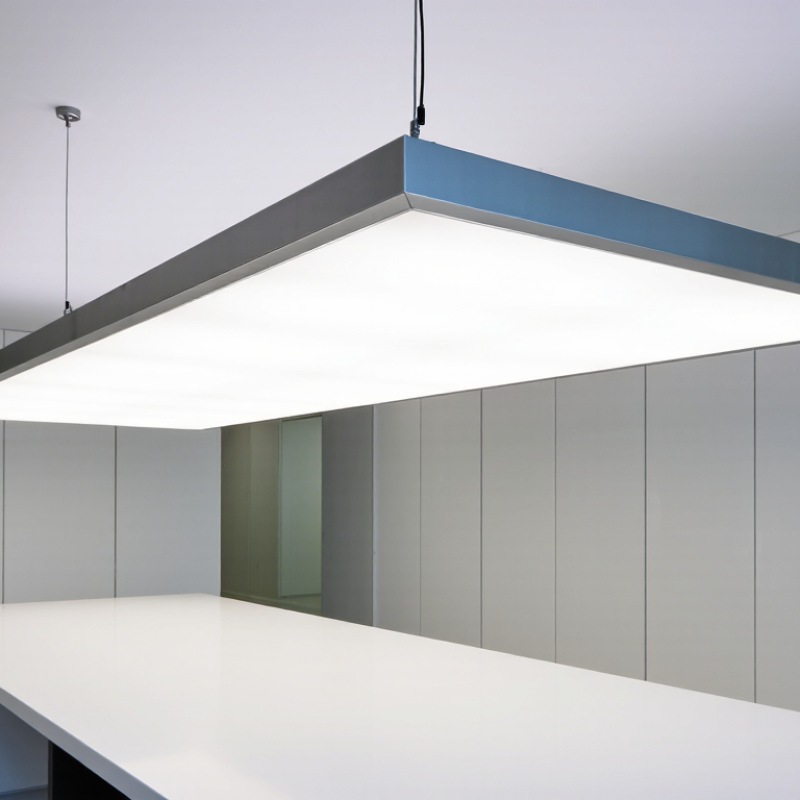
What Is a Suspended LED Panel?
A suspended LED panel is a flat lighting fixture hung below a ceiling. It uses slim cables, rods, or adjustable suspension kits. Unlike a recessed panel, it remains visible and becomes part of the room’s design. The housing usually contains LED modules, a heat-management system, a driver, and a light diffuser. Its broad surface produces even illumination across desks, counters, or walkways. Some panels also direct light upward, creating a softer ceiling glow.
The working principle is simple. An electrical driver converts incoming current into stable power for the LEDs. The LED chips produce light, while the diffuser reduces harsh points and shadows. The International Energy Agency reports that LED lighting can use up to 90% less electricity than incandescent lighting. A U.S. Department of Energy report estimated that LEDs represented about 48% of installed U.S. lighting in 2020. These figures show strong efficiency gains, but performance still depends on design and installation.
In real interiors, suspension height matters.
A panel hung too low may create glare on computer screens. Hung too high, it may lose visual impact and useful brightness. Designers should check beam distribution, color temperature, glare ratings, and emergency-lighting requirements. A common mistake is choosing wattage before studying the room. That approach looks efficient on paper, yet it can produce uneven light. Small details matter. The ceiling finish, cable alignment, and diffuser quality often decide whether the panel feels refined or merely functional.

Core Components and Their Functions
A suspended LED panel is a slim lighting fixture hung below a ceiling by cables, rods, or a mounting frame. Its performance depends on several coordinated components, not the LED chips alone. The LED array converts electrical energy into light, while the circuit board spreads heat across the panel. Thermal control matters because excessive heat can reduce output and shorten component life.
The driver changes incoming power into a stable current for the LEDs. It also supports dimming and may connect with occupancy or daylight sensors. A diffuser sits below the LEDs, mixing bright points into a softer, wider beam. Its material affects glare, uniformity, and visual comfort. The housing provides structure and helps move heat away from the light source. The U.S. Department of Energy’s 2023 Solid-State Lighting R&D Opportunities report identifies higher efficacy and improved thermal management as continuing industry priorities. Efficiency is not only a chip specification.
Suspension hardware controls height, balance, and installation safety. A lower panel can reduce shadows over desks, but it may create glare on screens. The International Energy Agency’s 2024 Energy Efficiency report continues to identify efficient lighting as an important source of electricity savings in buildings. Still, real performance depends on layout, controls, maintenance, and user behavior. In practice, a panel may meet its rated output yet feel uncomfortable in a poorly designed room. That detail is easy to overlook.
What Is a Suspended LED Panel and How Does It Work? - Core Components and Their Functions
| Core Component | Primary Function | Typical Technical Data | How It Works | Practical Considerations |
|---|---|---|---|---|
| LED Light-Emitting Diodes | Convert electrical energy into visible light. | Common color temperatures: 2700–6500 K; typical service life: approximately 50,000 hours when properly operated. | Current passes through semiconductor junctions, causing electrons and holes to recombine and release photons. | Higher-quality LEDs generally provide more consistent brightness, color stability, and thermal performance. |
| LED Circuit Board | Holds and electrically connects the LED packages. | Usually a printed circuit board with copper conductors and heat-transfer features; aluminum-core boards may improve thermal dissipation. | The circuit distributes controlled current to groups of LEDs arranged in series, parallel, or a combination of both. | Board layout affects uniformity, electrical reliability, and heat management. |
| LED Driver | Regulates power supplied to the LEDs. | Converts building AC power, commonly 100–277 V AC, into regulated low-voltage DC; efficiency often exceeds 85%. | The driver controls current and voltage to prevent LED overload caused by input fluctuations or temperature changes. | A constant-current design is commonly used because LED brightness is strongly affected by current. |
| Diffuser or Light Guide Plate | Distributes light evenly across the panel surface and reduces visible hotspots. | Typically made from optical acrylic or polycarbonate; may use micro-prism, frosted, or etched patterns. | Optical textures scatter or redirect light from the LED array so the illuminated surface appears uniform. | Optical efficiency, glare control, and cleaning resistance depend on the diffuser material and surface design. |
| Reflective Backing | Redirects light toward the visible face of the panel. | Often uses a high-reflectance white coating or reflective sheet positioned behind the light guide. | Light traveling toward the rear of the panel is reflected forward, improving useful light output. | Damage, dust, or discoloration can reduce optical efficiency and create uneven illumination. |
| Aluminum Frame or Housing | Provides structural support and helps remove heat from internal components. | Lightweight aluminum is commonly used because it combines rigidity with good thermal conductivity. | Heat produced by the LEDs and driver is transferred to the housing and released into the surrounding air. | The housing should remain unobstructed so natural or assisted airflow can dissipate heat effectively. |
| Thermal Management System | Maintains LED and driver temperatures within safe operating limits. | May include aluminum heat spreaders, thermal interface materials, ventilation openings, or passive heat sinks. | Heat travels from the LED junction through the circuit board and housing before being released to the room. | Lower operating temperatures generally support longer life and slower lumen depreciation. |
| Suspension Cables or Rods | Hang the panel below the ceiling at a selected height. | Common systems use two or four adjustable suspension points; installation height is often selected for visual comfort and light distribution. | Cables or rigid rods transfer the panel's weight to ceiling anchors or a structural support system. | All anchor points must be suitable for the ceiling structure and rated for the panel load. |
| Ceiling Canopy and Mounting Hardware | Connects the suspension system to the ceiling and conceals electrical connections. | May include mounting plates, anchors, cable grippers, strain reliefs, and a decorative canopy. | The hardware distributes mechanical load while providing a protected route for the power cable. | Mounting must comply with local electrical and building regulations, especially for suspended fixtures. |
| Power and Control Wiring | Delivers electrical power and, where applicable, dimming or control signals. | Control methods may include 0–10 V, digital addressable lighting control, phase dimming, or wireless control. | The power conductors supply the driver, while separate control conductors adjust the driver's output level. | Wiring should be protected from mechanical strain and routed according to the installation instructions. |
| Diffuser Frame and Fasteners | Secure the diffuser, light guide, and internal layers in their correct positions. | Usually consists of an extruded metal frame, clips, screws, or removable retention brackets. | The frame maintains optical alignment and prevents internal components from shifting during installation or operation. | Loose fasteners may cause rattling, light leakage, or uneven illumination. |
| Emergency Lighting Module | Provides illumination during a mains power failure when included in the design. | Typically uses a rechargeable battery, charging circuit, indicator, and emergency control circuitry. | When normal power is interrupted, the module switches the light source to battery operation for a specified duration. | Battery condition and periodic functional testing are important for emergency-rated installations. |
| Optical and Electrical Safety Features | Improve user safety, visual comfort, and operating reliability. | May include low-flicker operation, glare control, short-circuit protection, over-temperature protection, and surge protection. | Electronic protection circuits monitor abnormal conditions and reduce or disconnect power when necessary. | Actual protection levels depend on the fixture design and the applicable electrical safety requirements. |
How a Suspended LED Panel Produces Light
A suspended LED panel produces light through semiconductor diodes, not heated filaments. Alternating current enters a driver, which converts it into controlled direct current. The driver also manages voltage and supports dimming. Inside each LED, electrons move across a semiconductor junction and release energy as visible light. A phosphor layer often changes some blue light into broader white light. The result reaches the room through a diffuser, while an optical layer spreads it across desks and walkways.
The fixture hangs from cables, rods, or a ceiling track. This position improves light distribution and can reduce harsh shadows on work surfaces. Heat still matters. An aluminum frame moves heat away from the LED board, because excessive temperature can reduce output and shorten component life. The U.S. Department of Energy reports that LED lighting uses at least 75% less energy and can last up to 25 times longer than incandescent lighting. However, performance depends on driver quality, ventilation, installation, and operating temperature. The energy saving is real, but not automatic.
Tips: Choose a panel with a suitable color temperature and low glare rating. Check the driver’s dimming compatibility before installation. Leave space around the upper housing for heat release. A brighter panel is not always better; excessive brightness can cause eye fatigue. In practice, room surfaces, mounting height, and diffuser design may change the result. My own judgment would remain cautious without reviewing photometric test data.
How the Suspension System Supports the Panel
What Is a Suspended LED Panel and How Does It Work?
How the Suspension System Supports the Panel
A suspended LED panel hangs below the ceiling on adjustable cables, rods, or slim support wires. The suspension system carries the panel’s weight and keeps its light surface level. Each cable connects to a ceiling anchor and a fixing point on the panel. These connections must match the ceiling structure, not just the decorative surface. I have found that small anchor mistakes can create visible tilting and unwanted movement.
Most systems use three or four suspension points. More points can improve stability, but they also require careful adjustment. Cable grippers allow installers to raise or lower each corner with millimeter-level control. This helps maintain an even gap above the panel.
A rigid rod provides stronger positioning, while wire offers a lighter visual appearance. Both options need correct load ratings.
The power cable should not carry mechanical weight. It should hang with a gentle curve and avoid sharp bends. A separate safety attachment can help prevent the panel from falling if one connection fails. During installation, checking the anchors, fittings, and panel alignment is essential.
After several weeks, the cables may settle slightly, especially in buildings with vibration or changing temperatures. Rechecking the level is sensible, although it is often skipped.
The suspension system is simple, but reliable support depends on every small connection.
Benefits, Limitations, and Common Applications
What Is a Suspended LED Panel and How Does It Work?
A suspended LED panel hangs below the ceiling on cables or slim rods. Its driver converts AC power into controlled DC output. Light then passes through edge-lit guides or a back-lit diffuser. The result is broad, even illumination across desks, corridors, and display areas. The suspension height can also shape the room’s visual scale. Small details matter here. Poorly adjusted cables may create uneven lines.
Benefits, Limitations, and Common Applications
Energy performance is a major advantage. The International Energy Agency reported that lighting represented about 15% of global electricity consumption in 2020. Efficient LED systems can reduce this demand, especially in buildings with long operating hours. The U.S. Department of Energy has also documented commercial LED luminaire efficacies above 100 lumens per watt. That figure is useful, but it is not the whole story. Real performance depends on controls, dirt, temperature, and maintenance.
Suspended panels suit offices, classrooms, libraries, retail interiors, and healthcare areas. Their indirect installation can soften ceiling clutter and improve task visibility. Yet glare remains a practical risk. Highly reflective desks may expose uncomfortable bright zones. Some panels also require compatible dimming controls, and their drivers may need replacement before the light frame does. Installation can be slower than surface mounting. Ceiling height, structural loading, and emergency-lighting rules need checking before purchase. A tidy ceiling is not automatically a comfortable one. The overlooked issue is lifecycle impact: energy savings matter, but material use and disposal deserve review too. Sources: International Energy Agency, Lighting 2020; U.S. Department of Energy, Solid-State Lighting research reports.
What Is a Suspended LED Panel and How Does It Work?
Typical illuminance targets for common spaces using suspended LED panels
LED chips convert electrical energy into light, while a diffuser distributes the light evenly. Suspension cables position the panel below the ceiling and can support direct or direct-indirect lighting.
Common benefits include uniform illumination, low energy consumption, long service life, reduced maintenance, and flexible mounting height.
Performance depends on ceiling height, optical design, glare control, suspension stability, and correct spacing. The chart shows typical design ranges, not guaranteed product output.
