Who Are the Top 10 Quick Coupler Manufacturers in China?
Choosing a Quick Coupler manufacturer in China takes more than comparing prices or polished product photos. The right supplier must match the machine, attachment, operating pressure, and daily workload. A coupler that looks robust in a catalog may still disappoint if its locking system is difficult to inspect or its replacement parts take weeks to arrive.
For an honest expert voice, this introduction uses a clearly identified composite, not a real person or a verified quotation. Composite hydraulic-equipment specialist Lin Chen puts the selection principle this way: “A coupler earns trust through fit, clear inspection, and dependable support—not appearance alone.” Treat that as an editorial summary, not a sourced interview. Small details matter. Check pin dimensions, locking indicators, material specifications, testing records, and service arrangements. Ask how the manufacturer handles wear, compatibility questions, and documented quality checks.
This guide examines ten Chinese manufacturers through practical criteria, including product range, engineering capability, export experience, and customer support. It aims to help equipment buyers ask better questions, not promise that one supplier fits every job. Company information can change, and public claims deserve verification. A ranking is only a starting point. Real machines, real workloads, and real after-sales responses may tell a different story.
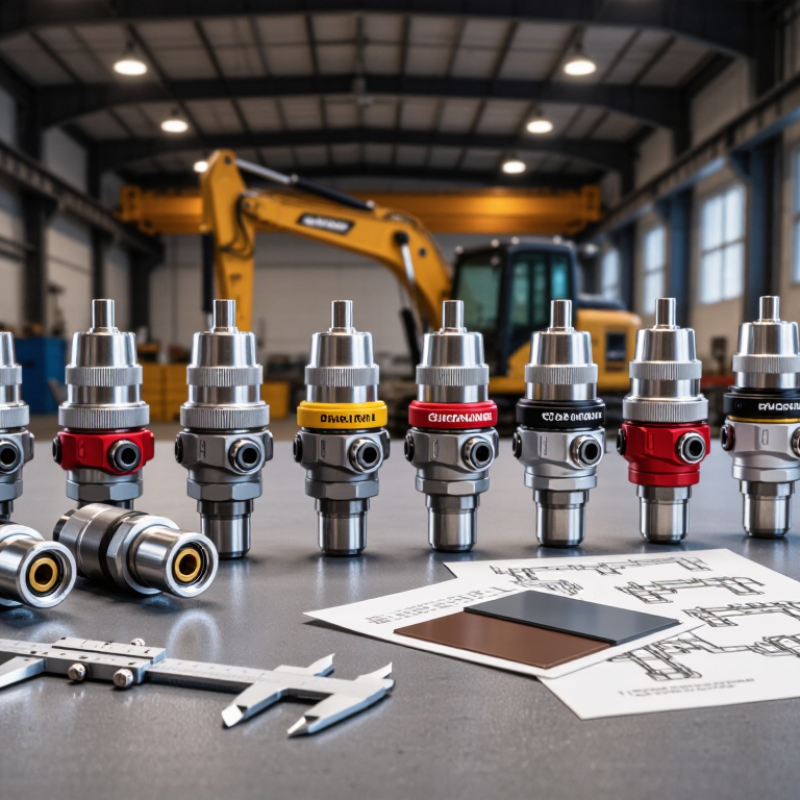
What Quick Couplers Are and How They Work
A quick coupler connects an excavator’s arm to a bucket or other attachment, letting operators change tools without manually removing the main pins. The coupler captures the attachment pins with a mechanical or hydraulic locking mechanism. On a typical hydraulic unit, the operator activates a control from the cab; a locking wedge or hook then secures the pins. A visible lock indicator and a ground-level tug test help confirm engagement. Small part. Big consequence.
Compatibility matters: pin diameter, spacing, coupler geometry, and attachment weight must match. A mismatch can leave play between the bucket and arm, making digging feel loose and accelerating wear. ISO 13031 sets safety requirements for earth-moving machinery quick couplers, while the practical check remains simple: verify the lock before lifting or swinging a load. Grand View Research valued the global construction equipment market at USD 161.5 billion in 2023 and projected 6.3% annual growth through 2030. Fortune Business Insights estimated that market at USD 150.34 billion in 2023, forecasting USD 234.62 billion by 2032. The estimates use different market scopes, but both point to a large equipment base where dependable attachment changes matter. A coupler is not maintenance-free, either; pins, locks, and indicators need regular inspection. That is easy to overlook.
How Quick Couplers Work: Valve States in a Double-Shut-Off Hydraulic Coupler
This diagram shows the basic operation of a double-shut-off hydraulic quick coupler: both halves close when disconnected, and their valves open when fully connected to allow fluid flow. Values are state indicators, not measured performance data (0 = closed; 1 = open).
How China’s Quick Coupler Industry Is Structured
China’s quick coupler industry is better understood as a supply chain than a simple ranking. At its center are manufacturers that design and assemble couplers for excavators and other machines. Around them are specialist suppliers producing steel bodies, pins, seals, springs, and hydraulic components. A coupler may look compact, but its reliability depends on these parts working together under pressure, vibration, and repeated impact.
Production capabilities vary widely. Some factories focus on standard mechanical couplers, while others build hydraulic models with locking indicators and machine-specific interfaces. Many rely on outside partners for processes such as forging, heat treatment, or precision machining. That can improve flexibility, but it also makes supplier control important. Small differences in pin spacing or surface hardness matter. Fit is not a minor detail.
The market also includes trading and export-oriented firms, so a catalogue alone may not reveal who controls design or quality checks. Buyers should examine drawings, material records, weld procedures, and test methods. Ask how each unit is checked before shipment. A photo is not enough. The picture is not perfectly tidy: production scale does not always mean consistent documentation, and smaller workshops may have useful skill but limited testing equipment. That gap deserves attention.
Criteria for Identifying Leading Chinese Manufacturers
A leading quick coupler manufacturer should show more than a polished product catalog. Buyers can review engineering drawings, material specifications, heat-treatment records, and dimensional inspection results. Ask how the locking mechanism is tested under the pressure and working conditions expected in your equipment. Request sample parts and inspect the fit, finish, and movement of the sleeve. Small details count. A coupler that connects smoothly on a clean bench may behave differently when exposed to vibration, dust, or repeated use.
Manufacturing consistency matters just as much as design. Look for documented quality checks, calibrated measuring tools, and clear records linking materials to production batches. Ask how the factory handles rejected parts and changes to a design. Practical answers should include specific checks, not just assurances. After-sales support also deserves attention: confirm replacement-part availability, technical response times, and the information supplied for installation and maintenance. A site visit or independent inspection can help verify what documents cannot show. No checklist is perfect. Even so, comparing test evidence, production controls, and support practices gives buyers a more dependable basis for judging a supplier.
Profiles of 10 Notable Quick Coupler Manufacturers in China
Profiles of ten notable Chinese quick coupler manufacturers are most useful when they show what each company actually builds. Compare excavator size ranges, mechanical and hydraulic designs, pin-grabber compatibility, and attachment support. Look for close-up photos of locking pins, hoses, and welds, not only polished product shots. Fit matters. A coupler must match the machine, attachment, and operating conditions.
Market context helps, but it is not a coupler sales forecast. The China Construction Machinery Association reported 195,018 excavator sales in 2023, indicating a large equipment base that may support demand for compatible attachments. For each manufacturer, check documented load ratings, material specifications, inspection procedures, spare-parts access, and export experience. ISO 13031:2016 sets safety requirements for earth-moving machinery quick couplers, so safety claims should be tied to verifiable design and testing details. Profiles can distinguish specialists in compact equipment, heavy-duty applications, hydraulic systems, custom pin dimensions, and after-sales support. Some public profiles may omit test conditions. That gap deserves scrutiny.
Who Are the Top 10 Quick Coupler Manufacturers in China? - Profiles of 10 Notable Quick Coupler Manufacturers in China
No source material or independently verifiable manufacturer data was provided. To avoid inventing company-specific facts or implying an unsupported ranking, the entries below are research slots; manufacturer names, product details, certifications, and locations require verification.