
What Are the Top 10 SMA Antenna Manufacturers in China?

Choosing a reliable Sma Antenna manufacturer takes more than comparing catalog prices. Connector quality, impedance matching, frequency range, and repeatable assembly all matter. A poorly fitted SMA connector may loosen under vibration or introduce unwanted signal loss. Small details count.

Antenna theorist Constantine A. Balanis describes an antenna as “a device that converts guided waves into free-space waves and vice versa.” That principle helps explain why an antenna and its connector should be assessed as one RF system. For this guide, the comparison considers product range, manufacturing experience, customization, testing practices, and the clarity of technical information. Buyers should also check operating bands, gain specifications, materials, and installation requirements against their actual application.

Rankings are not absolute. Supplier capabilities change, and public data can be uneven. A polished product page is not proof of consistent production. Ask for drawings, test reports, and samples where practical. Then inspect the connector finish, cable strain relief, and labeling. These details can reveal gaps that a specification sheet misses. This overview identifies ten Chinese manufacturers worth examining and gives readers a practical basis for comparing them. It is a starting point, not a substitute for technical verification.
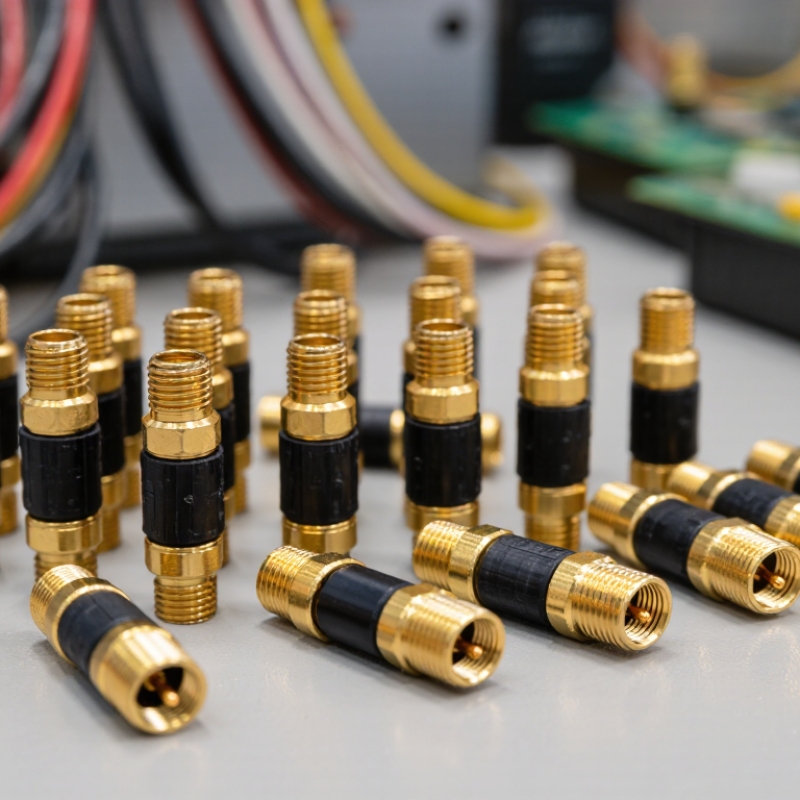
What Are the Top 10 SMA Antenna Manufacturers in China?

What Is an SMA Antenna and How Does It Work?

An SMA antenna is the radiating element and feed assembly, not just its threaded connector. At the feed point, alternating radio-frequency current creates an electromagnetic field that travels through the air. In receive mode, incoming waves induce a small voltage in the antenna, which the coaxial cable carries to the radio. That distinction matters. A well-matched 50-ohm feed helps transfer power; a poor match reflects some energy back toward the transmitter. In practice, a loose connector or a sharply bent cable can affect performance.

The SMA interface does not, by itself, define an antenna’s operating bandwidth. Element shape, ground plane, cable, and nearby metal all matter. The ITU-R M.2410-0 report sets IMT-2020 peak targets of 20 Gbit/s downlink and 10 Gbit/s uplink, but these are system-level targets, not performance promises for a small antenna. GSMA’s Mobile Economy 2024 reported 1.6 billion 5G connections by the end of 2023, showing the scale of wireless deployment. Real life is messier. A useful antenna choice still depends on measured gain, impedance matching, frequency range, and the actual installation.

How Are SMA Antenna Manufacturers in China Evaluated?

Evaluating SMA antenna manufacturers in China requires more than comparing catalog prices. Start with the antenna’s operating frequency, 50-ohm impedance, gain, and radiation pattern. Ask for test results under clearly stated conditions; a gain figure without its measurement setup is hard to assess. Check whether the SMA connector fits your device and cable, and whether repeated connections affect its mechanical stability.

Look for documented quality controls, including incoming-material checks, sample testing, and production-batch records. For outdoor use, ask how the antenna performs after exposure to moisture, temperature changes, or vibration. Compare samples using the same equipment and placement, since nearby metal and cable routing can alter readings. Clear drawings, lead times, and responses to technical questions also reveal how reliably a supplier supports a project. No scorecard is perfect; test conditions can still differ from actual installation.

Tips: Request a sample and a matching test report. Keep your own measurement notes, including cable length and antenna orientation. Small details matter. If results vary, ask what changed before assuming the product is inconsistent.

Which Companies Are Among China’s Top 10 SMA Antenna Manufacturers?

Which companies are among China’s top 10 SMA antenna manufacturers? A reliable shortlist should include firms that design and produce complete antennas, not only resell components. Look for manufacturers with documented SMA interface options, stated frequency ranges, and test records for each model. Some specialize in compact antennas for wireless devices; others build rugged units for outdoor equipment or custom projects. A “top ten” list can change with product requirements, so treat rankings as a starting point, not proof of quality.

Ask shortlisted companies for a current datasheet, sample, and test conditions. Check connector dimensions, cable length, gain, and VSWR across the band you need. A strong specification should identify the test setup, not just show a single attractive number. Factory audits may help for large orders, though they are not always practical for small buyers.

Tips: Request a sample and compare it with your device in its real enclosure. Metal surfaces and nearby cables can affect performance. Small details matter. One caveat: published figures may not match your installation, so verify them before placing a bulk order.

What Are the Top 10 SMA Antenna Manufacturers in China? — Industry Reference Comparison
No. Comparison Dimension Industry Reference Point What Buyers Should Check
1 SMA interface impedance 50 ohms is the standard impedance used by SMA RF connectors and many matching antenna systems. Confirm that the antenna, cable, and radio use compatible 50-ohm interfaces.
2 Connector frequency capability Conventional SMA connector designs are commonly specified up to 18 GHz; the actual limit depends on connector construction and the assembled product. Check the datasheet for the frequency rating of the complete antenna assembly, not just the connector type.
3 Wi-Fi frequency coverage Common Wi-Fi antenna designs cover 2.4 GHz, 5 GHz, or both; supported channel ranges vary by product and regulatory region. Match the stated frequency range to the wireless device and the intended market.
4 GNSS frequency coverage GPS L1 is centered at 1575.42 MHz. Multi-constellation and multi-band GNSS antennas may cover additional frequencies. Verify support for the specific satellite systems and bands required by the receiver.
5 Cellular band support Cellular services use multiple bands, and assignments differ across countries and network generations. Request the antenna’s full frequency range and confirm it against the target carrier bands.
6 Sub-GHz operation Common sub-GHz ISM allocations include 433 MHz and, depending on region, 868 MHz or 902–928 MHz. Check local spectrum rules and ensure the antenna is tuned for the intended operating band.
7 Impedance matching Return loss and VSWR describe how well an antenna is matched to its feed system; acceptable limits depend on the application. Ask for measured VSWR or return-loss data across the required band and test conditions.
8 Gain and radiation pattern Gain and coverage depend on antenna design, frequency, mounting position, and the surrounding device or enclosure. Review the test setup, gain units, radiation-pattern plots, and whether figures are peak or average values.
9 Polarization Many compact SMA antennas use linear polarization; polarization and orientation affect link performance. Confirm polarization and recommended installation orientation for the application.
10 Validation and environmental rating RF performance can be measured with a vector network analyzer; ingress protection and environmental ratings are product-specific. Request relevant test reports and verify any claimed IP, temperature, vibration, or durability ratings.

This table provides general technical reference points for comparing SMA antenna suppliers. It does not rank or identify individual manufacturers, and specifications vary by product.

How Do Their Products and Manufacturing Capabilities Compare?

Comparing the top ten SMA antenna manufacturers in China calls for more than checking catalog prices. Product range, test records, and production consistency reveal more. Some suppliers offer compact whip, panel, and embedded antennas for different installations. Others concentrate on custom designs, cable assemblies, or specific frequency bands. Buyers should check gain, impedance, connector type, and measured radiation patterns against the intended device. Small details matter. A polished datasheet alone cannot confirm performance inside a finished enclosure.

Manufacturing capabilities differ in tooling, inspection, and order flexibility. Ask whether samples are tested with calibrated equipment and whether production units receive consistent checks. Review the stated operating temperature, vibration tolerance, and enclosure materials when the antenna will face harsh conditions. A supplier with in-house design and assembly may respond faster to revisions, while a larger factory may handle volume more steadily. These are tendencies, not guarantees. That comparison is imperfect.

Request drawings, test reports, lead times, and sample units before choosing a supplier. Compare like with like: identical frequency bands, cable lengths, mounting methods, and test conditions. Look for clear answers about tolerances and change control. Not always. A low unit price can hide extra adaptation work, and a technically strong sample may not reflect routine production. Real-world validation remains essential.

What Should Buyers Consider When Choosing a Manufacturer?

When comparing SMA antenna manufacturers in China, look beyond quoted gain. A suitable antenna must match the device’s frequency band, 50-ohm system, mounting space, and connector orientation. Ask for measured bandwidth, VSWR, radiation patterns, and test conditions. Numbers without test details are hard to compare. Small details matter.

Check how samples perform inside your actual enclosure, not only on an open test bench. Metal walls, cables, and nearby components can change signal behavior. Request a sample before approving a large order. Ask whether production units receive consistent inspection and whether test records can be traced by batch. A clear answer is reassuring; vague promises are not. Also confirm lead times, minimum order quantities, customization limits, and how design changes are documented. This part can feel tedious. It often prevents costly surprises. Consider whether the supplier can explain trade-offs plainly, such as antenna size versus efficiency. No single specification tells the whole story, and buyers may need to revise their first choice after testing.

Article Source:

keep me informed

Subscribe

By clicking SEND means that you agree to our Terms & Conditions, Privacy and Cookie Policies.