
Top HEPA Air Filter Manufacturers in China

Choosing among the Top Hepa Air Filter Manufacturers in China takes more than comparing prices or polished product photos. Buyers need evidence: tested efficiency, stable airflow, clear specifications, and traceable quality controls. The U.S. Environmental Protection Agency explains that HEPA filters can theoretically capture at least 99.97% of particles at 0.3 microns. That benchmark is useful, but it does not tell the whole story. Fit, sealing, pressure drop, and the equipment’s airflow also matter. Details matter.

Air quality makes this scrutiny practical, not academic. IQAir’s 2023 World Air Quality Report found that only seven countries and territories met the World Health Organization’s annual PM2.5 guideline. That finding does not measure demand for Chinese-made filters, but it shows why dependable particle filtration remains important. ASHRAE fellow William P. Bahnfleth, an expert in building ventilation and filtration, has emphasized a principle buyers should keep in view: filter efficiency must be considered alongside airflow and system performance. A strong rating alone is not enough.

This guide examines Chinese manufacturers through product data, manufacturing capabilities, testing documentation, customization, and export support. Look for independent test reports, clearly stated test methods, and consistent model-level specifications. Ask how each filter performs under the airflow your application requires. A spreadsheet cannot reveal every production weakness. Supplier claims also deserve verification. The goal is not to crown a factory from a catalog, but to identify a partner whose Air Filter Hepa products can be evaluated with evidence, checked against real operating needs, and supported after delivery.
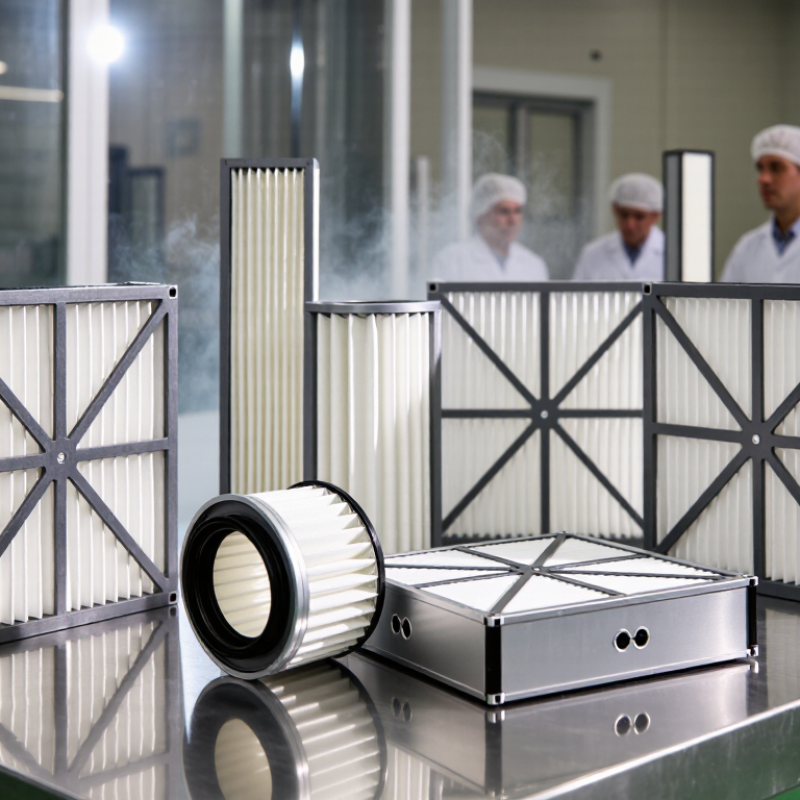
Top HEPA Air Filter Manufacturers in China

Understanding HEPA Air Filters and Their Role in Air Purification

HEPA means high-efficiency particulate air filtration. In a commonly cited U.S. benchmark, a HEPA filter captures at least 99.97% of particles measuring 0.3 micrometers under specified test conditions. This size is difficult to capture, so it serves as a useful performance reference. Not every market uses identical standards.

The filter media traps particles through several mechanisms, including interception and diffusion. That matters. A dense pleated sheet can capture fine dust, pollen, and some airborne particles, but it does not remove every gas or odor.

A filter’s real performance also depends on its frame and seal. Even a small gap can let air bypass the media, like water slipping around a clogged drain. Fan strength and room airflow matter, too. A high-efficiency filter may restrict airflow if the system is not designed for it.

Check the equipment’s specifications and replace filters as directed. A gray surface can look alarming, but appearance alone cannot show how well a filter performs.

HEPA is useful, not magic.

China’s HEPA Filter Manufacturing Landscape

China’s HEPA filter manufacturing landscape includes large-scale producers and smaller specialists serving commercial, industrial, and cleanroom applications. Their capabilities can differ considerably. Some factories make filter media and finished units in-house; others rely on outside suppliers for key materials. This affects lead times, traceability, and how quickly production issues can be investigated.

Reliable output depends on more than a stated efficiency rating. Buyers should review test methods, quality records, and production controls, including checks for leaks around filter frames and seals. A factory visit can reveal practical details: how media pleats are spaced, whether adhesive application is consistent, and how finished filters are protected from dust. Ask how rejected units are handled. Details matter. Documentation should match the exact model being purchased, not just a similar product.

Export experience, customization, and technical support also vary across manufacturers. Clear drawings and agreed inspection criteria help prevent misunderstandings about dimensions, airflow, or installation requirements. Claims are not always easy to verify from a catalogue alone. Requesting recent test reports and discussing how samples are tested can offer a more grounded view of a supplier’s capabilities. One imperfect point: a clean sample does not guarantee every production batch will be identical.

Top HEPA Air Filter Manufacturers in China - China’s HEPA Filter Manufacturing Landscape
An overview of common product categories, standards, materials, and applications. This is a non-ranked industry snapshot; no company or brand names are included.
Dimension Common products or practices Relevant reference Typical use or note
High-efficiency filter grades Products are commonly specified by a filter class such as H13 or H14, where applicable. EN 1822 and ISO 29463 classify high-efficiency filters using efficiency at the most penetrating particle size (MPPS). The stated class should be verified against the test method and edition specified in the product documentation.
H13 performance reference Under EN 1822, H13 corresponds to an overall efficiency of at least 99.95% at MPPS. EN 1822 classification and testing requirements. This is a classification threshold, not a guarantee for every filter marketed as “HEPA”; check the applicable test report.
H14 performance reference Under EN 1822, H14 corresponds to an overall efficiency of at least 99.995% at MPPS. EN 1822 classification and testing requirements. Higher efficiency can increase airflow resistance; selection should account for the system’s fan and pressure-drop limits.
Filter media Fine-fiber media, including glass-fiber and certain synthetic-fiber constructions, are used in high-efficiency filtration products. Media choice is a product-design characteristic; efficiency and pressure drop require testing on the finished filter. Media, pleat geometry, separators, and seal design all affect filter performance.
Filter construction Common configurations include pleated panels, compact or mini-pleat filters, and deep-pleat filters. Construction and dimensions are product-specific; there is no single configuration required for all HEPA filters. Frame materials and gasket or gel-seal arrangements are selected to suit the housing and installation conditions.
Leakage and integrity testing Individual high-efficiency filters may be scanned for local leaks as part of classification or quality-control testing. EN 1822 and ISO 29463 include methods for testing high-efficiency filter performance and integrity. Ask whether the supplied report covers the finished filter and which test aerosol, method, and acceptance criteria were used.
Product specification Key specification fields commonly include rated airflow, initial pressure drop, dimensions, efficiency class, and operating limits. Values should be stated with their test conditions and the referenced standard. Comparisons are meaningful only when airflow, dimensions, test conditions, and classification basis are comparable.
Cleanroom applications High-efficiency filters are used in cleanroom air-handling systems and terminal filter units. The required filter grade depends on the facility design and its contamination-control requirements. Filter selection is part of a broader system design that includes airflow distribution, sealing, and maintenance.
Other application sectors HEPA-grade filtration is also used in selected healthcare, laboratory, pharmaceutical, and industrial air-filtration systems. The required grade and configuration are set by the application and system specification. A filter’s classification alone does not establish suitability for every process or environment.
General ventilation context Coarse and fine filters may be used upstream to capture larger particles and help protect downstream high-efficiency filters. ISO 16890 is a classification standard for general-ventilation air filters; it is distinct from HEPA classification under EN 1822 or ISO 29463. A staged filtration system can be designed to match the required air quality and operating conditions.
Note: Classification thresholds and test requirements are standard-specific. Confirm the current standard edition, product test report, and system operating conditions before procurement.

Key Criteria for Evaluating Chinese HEPA Filter Manufacturers

When evaluating Chinese HEPA filter manufacturers, look beyond catalog ratings. Ask which classification standard they use, such as EN 1822 or ISO 29463, and request recent test reports for the exact filter model. Check whether reports identify the test method, airflow, pressure drop, and particle efficiency. A rating without test conditions is hard to compare.

Inspect how quality is maintained during production. Ask about media suppliers, frame sealing, batch traceability, and leak testing. A practical audit might follow one filter from its material records to its final inspection label. Look for clear procedures, calibrated instruments, and retained test data. Paperwork can look convincing. It is not the filter.

Also assess whether the manufacturer can support your operating conditions. Share the required airflow, installation dimensions, temperature, and acceptable pressure drop. Request samples, then check fit and performance through an independent or agreed testing process. Ask how the factory handles failed inspections and product changes. No checklist catches everything. Response quality matters, though it is not a substitute for evidence. If answers stay vague, pause before placing a large order.

Profiles of Leading HEPA Air Filter Manufacturers in China

Leading HEPA air filter manufacturers in China are not all built around the same strengths. Some operate large production lines for standard panels and cylindrical cartridges. Others focus on cleanroom projects, where dimensions, frame materials, and documented testing matter more. A useful profile starts with process evidence, not polished catalog language. Ask how media pleats are spaced, how separators are handled, and how each finished unit is checked. Small details count.

Manufacturers serving hospitals, laboratories, and electronics facilities may offer different grades and configurations. Their teams should explain efficiency ratings, airflow resistance, sealing methods, and test conditions in plain terms. Look for traceable inspection records and clear sampling procedures. A factory tour can reveal practical clues: clean worktables, labeled lots, and instruments with current calibration records. These signs help, but they do not replace independent verification.

Export-oriented suppliers often support custom sizes and private-label production, while smaller workshops may respond quickly to unusual orders. Capacity claims deserve careful checking; a sample may not reflect every production batch. Compare written specifications, test reports, lead times, and packaging before judging fit. There is no perfect profile. Even reliable suppliers can have limits, especially when designs change late or material availability shifts.

Applications, Certifications, and Quality Standards for HEPA Filters

HEPA filters are used in hospital isolation rooms, pharmaceutical cleanrooms, laboratories, and electronics production areas. Each setting has different airflow needs. A cleanroom handling fine powders, for example, may require carefully controlled pressure drop and a verified housing seal. A high-efficiency filter alone cannot correct poor installation.

For buyers comparing HEPA filter manufacturers in China, check the intended application and the test evidence behind each grade. EN 1822 and ISO 29463 classify filters using measured particle performance, including testing at the most penetrating particle size. China’s GB/T 13554-2020 provides a national standard for high-efficiency air filters. Ask for the relevant test report, filter efficiency, airflow, and initial resistance—not just a product label. Fit matters.

Quality checks should include media integrity, frame dimensions, gasket condition, and leakage testing. Request batch records and confirm that test conditions match the equipment in which the filter will operate. A certificate is useful, but it does not guarantee a sound installation or consistent performance over time. I would also compare pressure-drop data carefully; a lower figure is not automatically better if the filter misses the required efficiency. Paperwork can reassure. Real operating conditions still deserve a closer look.

HEPA Filter Classes: Maximum Particle Penetration

EN 1822 classification limits at the most penetrating particle size (MPPS). Lower penetration indicates higher filter efficiency.

E10–E12 are EPA classes; H13–H14 are HEPA classes; U15–U17 are ULPA classes. Actual selection depends on the application, system design, and verified filter test results. Reference: EN 1822.

keep me informed

Subscribe

By clicking SEND means that you agree to our Terms & Conditions, Privacy and Cookie Policies.