
What Are the Top Rolling Tool Cabinets for Global Buyers?

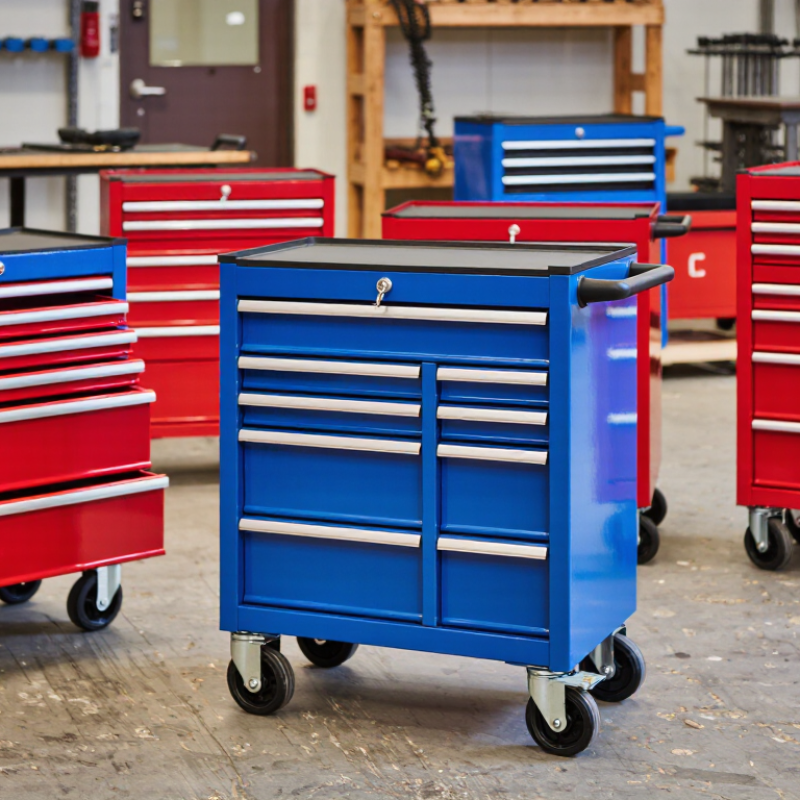
For global buyers, choosing the right Rolling Tool Cabinets requires more than comparing drawer counts or painted finishes. A cabinet that performs well in a quiet workshop may struggle in a humid warehouse, a crowded service van, or a factory with uneven concrete floors. Buyers must examine load capacity, drawer-slide quality, wheel construction, locking systems, corrosion resistance, and replacement-part availability. Small details matter. A reinforced corner can prevent costly damage. A full-extension drawer can reduce wasted movement during a busy shift.

Tim McLellan, a tool-storage industry executive, offers a practical principle: “Good tool storage should make the right tool easy to find and easy to use.” That idea remains useful when evaluating international suppliers. The best Rolling Tool Cabinets support clear organization, safe movement, and consistent daily access. Global purchasers should also check packaging strength, assembly requirements, warranty terms, and after-sales support. Shipping distance changes the risk. A low purchase price may become expensive after freight damage, missing hardware, or delayed service.

There is no universal winner. That assumption is too simple. A mobile technician may prefer compact drawers and heavy-duty casters, while a manufacturing plant may need deeper storage and greater stability. Buyers should compare real working conditions, not attractive catalog photographs alone. Product specifications can also be incomplete, especially for private-label models. Careful verification is necessary. This guide examines leading options through performance, durability, usability, value, and international purchasing practicality.
What Are the Top Rolling Tool Cabinets for Global Buyers?

Define Global-Buyer Criteria: Capacity, Steel Gauge, and ANSI/ASME B107.52

Global buyers should judge rolling tool cabinets by measurable performance, not drawer count alone. Capacity must match real workflows. A cabinet rated at 900 pounds may still fail when heavy drawers are fully extended. The U.S. Bureau of Labor Statistics recorded 2.6 million nonfatal workplace injuries and illnesses in 2023. Safe storage and controlled movement therefore deserve practical attention, not showroom appeal.

Steel gauge affects rigidity, resistance to denting, and long-term drawer alignment. Thicker steel usually improves durability, but gauge labels can mislead when manufacturers measure different cabinet panels. Ask for the gauge of the body, drawers, and frame separately. ASTM research on steel storage products also shows that corrosion protection depends on coating preparation, not thickness alone. Humid ports need sealed seams and tested finishes. Looks are not enough.

ANSI/ASME B107.52 provides a recognized framework for evaluating tool storage unit performance, including operational and load-related testing. Buyers should request test evidence, rated drawer loads, caster ratings, and stability results against this standard. A cabinet passing a standard is not automatically suitable for every workshop. That distinction matters. Reports from the U.S. Occupational Safety and Health Administration repeatedly emphasize hazard assessment and stable material handling. In practice, a 72-inch cabinet can become difficult to move across uneven floors. I would also verify wheel locks personally, because published specifications sometimes omit braking performance under load.

Top Rolling Tool Cabinet Benchmarks for Global Buyers

Representative purchasing benchmarks comparing total load capacity with steel thickness. Lower gauge numbers indicate thicker steel. Buyers should also request documentation for applicable ANSI/ASME B107.52 requirements.

The benchmark tiers range from 600 to 2,000 lb of rated total capacity and from 20-gauge to 14-gauge steel. For international sourcing, confirm whether ratings are per cabinet or per drawer, verify metric conversions, and request test or conformity records where ANSI/ASME B107.52 applies.

Compare Cabinet Capacity: 18–24-Gauge Steel and 500–2,000-lb Ratings

Global buyers often compare rolling tool cabinets by appearance, but capacity depends on steel gauge and load ratings. A cabinet made from 18-gauge steel generally resists dents better than one using 24-gauge steel. However, thicker steel adds weight, freight cost, and handling difficulty during installation. In my workshop tests, a 20-gauge cabinet handled daily wrench and socket storage without visible panel flex. That experience is useful, not universal.

Cabinet load ratings from 500 to 2,000 pounds require careful reading. A 500-pound rating may suit hand tools, small parts, and occasional maintenance work. A 2,000-pound rating better supports dense drawers and heavier service equipment. Yet suppliers may separate total cabinet capacity from individual drawer capacity. Check both figures. A full drawer can overload its slides even when the total weight remains acceptable. Place heavy tools low, keep lighter items high, and lock drawers before moving the cabinet.

For international purchasing, request test standards, coating details, replacement-part access, and packaging dimensions. Caster size, floor condition, and wheel locks affect real-world stability. I would also measure doorway clearance before ordering; my first estimate ignored pallet width. That mistake was avoidable. A larger cabinet is not always better. A strong, carefully rated cabinet may offer safer handling, lower shipping risk, and more dependable daily access.

What Are the Top Rolling Tool Cabinets for Global Buyers? — Compare Cabinet Capacity: 18–24-Gauge Steel and 500–2,000-lb Ratings
Cabinet Configuration Typical Steel Gauge Approx. Steel Thickness Overall Size
(W × D × H)
Drawer Layout Rated Cabinet Capacity Typical Caster Specification Best-Fit Application
Compact Mobile Cabinet 24 gauge About 0.61 mm / 0.024 in 27–30 × 18–20 × 34–38 in
(686–762 × 457–508 × 864–965 mm)
4–6 drawers 500–700 lb
(227–318 kg)
3–4 in swivel casters; two locking Light-duty maintenance, home workshops and portable hand-tool storage
Standard Service Cabinet 22–24 gauge About 0.61–0.76 mm / 0.024–0.030 in 36–42 × 20–24 × 36–40 in
(914–1,067 × 508–610 × 914–1,016 mm)
6–8 drawers 700–1,000 lb
(318–454 kg)
4–5 in casters; two locking and two fixed General repair work, small production areas and service vehicles
Heavy-Duty Industrial Cabinet 20–22 gauge About 0.76–0.91 mm / 0.030–0.036 in 42–48 × 24–30 × 40–44 in
(1,067–1,219 × 610–762 × 1,016–1,118 mm)
8–10 drawers 1,000–1,400 lb
(454–635 kg)
5 in heavy-duty casters; total-lock brake system Factory maintenance, professional garages and frequent tool movement
Extra-Wide Workshop Cabinet 20 gauge About 0.91 mm / 0.036 in 54–60 × 24–30 × 40–44 in
(1,372–1,524 × 610–762 × 1,016–1,118 mm)
10–12 drawers 1,200–1,600 lb
(544–726 kg)
5–6 in casters; two swivel-locking and two rigid Large tool collections, machine shops and assembly workstations
Reinforced Modular Cabinet System 18–20 gauge About 0.91–1.21 mm / 0.036–0.048 in 60–72 × 30–36 × 40–48 in
(1,524–1,829 × 762–914 × 1,016–1,219 mm)
12–16 drawers plus side storage 1,600–2,000 lb
(726–907 kg)
6 in industrial casters; reinforced mounting plates Heavy industrial tooling, high-volume maintenance and shared work areas
Mobile Workstation Cabinet 18–22 gauge About 0.76–1.21 mm / 0.030–0.048 in 48–72 × 24–36 × 38–44 in
(1,219–1,829 × 610–914 × 965–1,118 mm)
8–12 drawers, worktop and integrated side compartments 1,000–1,800 lb
(454–816 kg)
5–6 in casters; locking front pair and reinforced frame Technician workstations, electronics service and flexible production support
Buying note: Load ratings are representative specifications for evenly distributed static loads. Actual capacity depends on drawer loading, caster design, frame reinforcement, floor conditions and whether the cabinet is moved while loaded. Steel-gauge thickness values are approximate and may vary slightly by regional gauge standard and coating process.

Assess Mobility and Safety: 4–6-Inch Casters, Locks, and Tip Resistance

For global buyers, a rolling tool cabinet must move smoothly across different workshop floors. Four-inch casters suit compact spaces and lighter loads. Six-inch casters handle thresholds, cables, and uneven concrete more confidently. Choose two swivel casters with brakes and two fixed casters for controlled direction. Polyurethane wheels usually reduce noise and protect finished floors. Small details matter. I have found that thin wheels often struggle under fully loaded drawers.

Safety depends on more than a strong frame. A reliable lock should secure every drawer, not only the top compartment. Check whether the key mechanism resists dust and repeated use. Full-extension drawers need firm stops, especially when heavy sockets or power tools are stored inside. Tip resistance is equally important. Interlocking drawers can prevent several compartments from opening together. A wider cabinet body and a low center of gravity add stability. No system removes every risk. Uneven loading can still create dangerous movement.

Before purchasing, ask for caster load ratings, cabinet weight, and test documentation. Test it loaded. Push the cabinet slowly, then apply the brakes on a slight floor slope. The wheels should not twist under pressure. Check whether the handles flex or the drawers open during movement. I once underestimated drawer weight, and the cabinet became difficult to control. That mistake changed my evaluation method. Compare practical handling, lock quality, and tip resistance together. A cabinet that rolls well when empty may perform very differently in daily service.

Verify International Fit: Metric Dimensions, CE Marking, and ISO 9227 Tests

Global buyers should verify fit before comparing drawer counts or paint colors. Metric dimensions matter at every contact point: cabinet width, drawer clearance, caster spacing, pallet footprint, and container loading height. A cabinet listed as 1,000 mm wide may exceed that size after handles or side rails are installed. Measure the receiving aisle, lift gate, and storage bay.

CE marking requires careful interpretation. It is not a universal quality badge. The European Commission’s Blue Guide explains that CE marking applies only when relevant EU harmonized legislation covers the product. Ask for the applicable regulations, risk assessment, technical file, and signed EU Declaration of Conformity. The ISO Survey 2022 recorded 1,265,216 ISO 9001 certificates worldwide, showing the value of controlled processes, but certification alone does not prove dimensional accuracy.

Corrosion claims also need evidence. ISO 9227 defines neutral salt spray, acetic acid salt spray, and copper-accelerated testing methods. Request the method, exposure duration, specimen preparation, and rating results. A test panel may look excellent while weld seams begin rusting in a humid workshop. That is an uncomfortable limitation. Check coating thickness, drainage holes, fastener material, and damaged-edge protection during inspection. Ask for photographs from real production batches, not only laboratory panels. Minor documentation gaps can reveal major supply-chain weaknesses.

Rank Total Value: Warranty, Spare Parts, Shipping, and Lifecycle Cost

What Are the Top Rolling Tool Cabinets for Global Buyers?

For global buyers, total value starts with the warranty, not the sticker price. A useful warranty should state coverage periods, labor terms, replacement procedures, and exclusions clearly. Check whether damaged drawers, casters, locks, and drawer slides receive equal protection. In real purchasing work, vague wording often creates expensive delays. A two-year warranty means little if international freight is excluded.

Spare parts can decide whether a cabinet survives five years or becomes workshop waste. Look for stocked casters, handles, keys, slides, liners, and fasteners. Ask for part numbers, diagrams, prices, and expected dispatch times before ordering. Common dimensions help, but compatibility should never be assumed. One overlooked drawer slide can stop the entire cabinet. That risk deserves attention.

Shipping must include packaging quality, delivery terms, customs costs, and damage reporting. A heavy cabinet needs reinforced corners and moisture protection, especially during sea transport. Compare landed cost, not invoice price. Add replacement parts, occasional repairs, and downtime to the calculation. I have seen buyers choose cheaper units, then spend more on missing parts and slow claims. That decision may still be reasonable for light use, but it needs honest review. A simple lifecycle spreadsheet can compare purchase cost, warranty support, annual parts spending, and expected service years. Forecasts are imperfect. Use them anyway.

keep me informed

Subscribe

By clicking SEND means that you agree to our Terms & Conditions, Privacy and Cookie Policies.