What Is a Silicone Cookie Spatula Used For?
A Silicone Cookie Spatula helps lift baked cookies from a tray and transfer them to a cooling rack. Its flexible head can slide beneath delicate edges while supporting a soft center. Small tool. Real difference. When chocolate chips remain warm and cookie bottoms feel fragile, that support matters. A suitable silicone edge also helps protect nonstick baking sheets from scratches during everyday use.
Culinary educator Julia Child offered a useful reminder about developing kitchen skills: “No one is born a great cook, one learns by doing.” Her observation applies to learning when and how to move freshly baked cookies. Even a well-designed spatula cannot rescue every rushed transfer. A cookie lifted too early may fold, crack, or leave its center behind. Letting cookies rest briefly on the baking sheet often improves handling, though timing depends on the recipe. Practice helps. So does noticing what went wrong.
Choosing a Silicone Cookie Spatula means looking beyond its color or a general “heat-resistant” label. Check the manufacturer’s temperature limit, cleaning instructions, and stated suitability for food contact before use. A thin leading edge helps with flatter cookies; a broader head offers support for larger ones. Very flexible silicone may struggle beneath a heavy cookie, making head stiffness another useful consideration. This guide explains its main uses, practical limitations, and the features worth checking before buying. The aim is simple: fewer broken cookies and more confident handling, with realistic expectations about what one utensil can do.
What Is a Silicone Cookie Spatula?
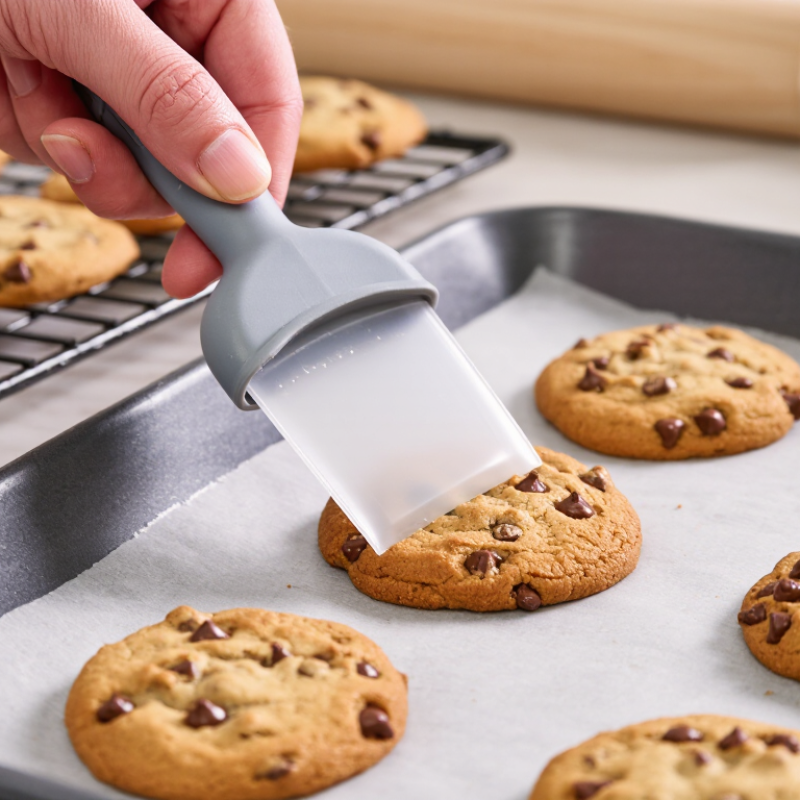
A silicone cookie spatula is a small kitchen turner designed to lift baked cookies from a tray. It has a broad, flat silicone head, usually supported by a firmer inner core. The front edge slides beneath cookies while the wider surface supports their soft centers. Shape matters. Unlike a spoon-shaped silicone scraper, this tool is designed mainly for lifting, rather than mixing dough or scraping bowls.
The silicone surface is gentle on nonstick baking sheets when used without excessive force. A thin, slightly flexible edge helps lift delicate sugar cookies without scraping their bottoms. Some heads measure around three inches across, although sizes vary. That extra width can support a warm chocolate chip cookie as you move it onto a cooling rack. However, very flexible models sometimes bend under thick, heavy cookies. A firmer head may work better for those batches.
Timing matters, too. Cookies often need a few minutes on the baking sheet before their centers become firm enough to move. Try lifting one edge gently; if the cookie folds, give the batch more time. A silicone spatula cannot completely prevent breakage, and choosing the softest head is not always the best decision. Check the manufacturer's heat limit and care instructions, since silicone utensils vary in construction and temperature tolerance. Inspect the edge occasionally for splits or exposed reinforcement.
What Is a Silicone Cookie Spatula Used For?
A silicone cookie spatula is a kitchen tool with a broad, flat silicone head used to lift cookies from a baking sheet and transfer them to a cooling rack or serving plate. Its flexible edge can slide beneath cookies, while its soft surface helps protect nonstick bakeware from scratches.
The chart below converts selected oven temperature settings from Fahrenheit to Celsius, providing a useful reference when following cookie recipes.
Use the spatula to gently lift cookies once they have set enough to move. Follow your recipe’s cooling instructions and check the utensil’s stated heat limit before touching a hot baking sheet. Oven temperature alone does not establish whether a particular spatula is suitable for that heat.
Data basis: °C = (°F − 32) × 5/9, rounded to one decimal place. These values are temperature conversions, not spatula heat ratings or recommended baking settings for every cookie recipe.
How Its Shape and Material Help Lift Cookies
A silicone cookie spatula helps lift baked cookies from a tray and move them onto a cooling rack. Its thin, tapered edge slides beneath the base with less pressure against delicate edges. A broad head supports more of the cookie, helping soft centers stay together during the move. Shape matters. For a cookie about three inches across, choose a head wide enough to support most of its underside.
Silicone bends slightly as you slide it against the tray, helping the edge reach beneath a cookie. However, flexibility needs support: an overly floppy head can sag under thick oatmeal cookies or large chocolate chip cookies. A firmer inner core can provide stability while the silicone surface stays gentle against nonstick coatings. Check for exposed edges or damage before use. Silicone tolerates heat, but temperature limits vary, so follow the utensil’s stated rating rather than assuming it is oven-safe.
Timing matters, too. Let freshly baked cookies rest on the tray until their edges feel set, often around two to five minutes. Slide the spatula almost parallel to the tray, then lift with the cookie centered on its head. A melted chocolate chunk may still smear, and a very soft center can wrinkle. Waiting longer may help, although the hot tray also continues cooking the bottoms.
When to Use It for Transferring and Serving Cookies
A silicone cookie spatula helps transfer baked cookies from a baking sheet to a cooling rack or serving plate. Use it when soft centers and delicate edges need support from underneath. Timing matters. For many drop cookies, start checking after two to five minutes on the baking sheet. Look for set edges and a base that lifts without folding. Slide the blade beneath most of the cookie before lifting. If the center sags, give it another minute.
Choose a thin silicone edge with enough internal support to carry the cookie without bending sharply. A thick, floppy blade can push a warm cookie into a wrinkle. That sounds minor. But broken cookies create avoidable waste, especially when preparing several trays for an event. A 2014 USDA Economic Research Service report estimated that 31% of the available U.S. food supply went uneaten in 2010. That represented approximately 133 billion pounds at retail and consumer levels. These figures cover food broadly; they do not measure cookie breakage or prove that spatulas reduce waste.
Use the spatula again when serving large cookies, crumbly shortbread, or sandwich cookies with soft fillings. Lift each cookie from underneath and lower it close to the plate. Keep the blade away from exposed filling to limit smears. Silicone can protect a coated tray from scratches, but trapped crumbs still need wiping away. It also has limitations: an unusually thick edge may struggle beneath thin, crisp cookies. Check the utensil’s stated temperature limit before touching a hot baking sheet.
How to Lift Cookies Without Breaking Them
A silicone cookie spatula helps lift baked cookies from a tray and transfer them to a cooling rack. Its broad head supports the center, where warm cookies often bend or split.
Choose a thin, tapered edge that can slide beneath the cookie without pushing it sideways. A flexible edge helps, but the head should feel firm enough to carry the cookie without sagging under its weight.
Let cookies rest on the baking sheet for about three to five minutes before attempting the transfer. Wait a little. The edges should look set, while the centers may still feel soft. Very large or delicate cookies may need longer, so treat the clock as a guide rather than a guarantee.
Slide the spatula almost parallel to the tray, using a gentle forward motion. Support most of the underside before lifting, then keep the cookie level as you move it toward the cooling rack.
If an edge wrinkles or the center droops, lower the cookie and give the batch another minute to firm up. Don’t force it. For a stuck cookie, gently work the thin edge underneath instead of pulling upward.
Silicone alone cannot prevent breakage; timing and adequate support matter just as much. A slightly cracked test cookie is useful feedback, though sacrificing one still feels frustrating when the batch is small.
Check the spatula’s stated heat limit before using it against a hot baking sheet.