
Why Choose an FPGA Chip for Your Project?
Choosing an Fpga Chip can change how a project handles parallel workloads, tight latency limits, and evolving requirements. Unlike a fixed-function device, an FPGA lets engineers configure logic to match a task, then revise that design as needs change. That flexibility is useful in industrial control, communications, imaging, and edge computing. It is not automatically the best choice.
MarketsandMarkets’ FPGA market report projected growth from about $9.8 billion in 2023 to $19.3 billion by 2028. Those figures describe a market forecast, not a guarantee of demand for any single design. They do signal growing interest in adaptable hardware. Clive “Max” Maxfield, an FPGA author and industry educator, has emphasized a central advantage: engineers can tailor hardware logic after manufacturing. That can shorten iteration cycles. It can also make verification more demanding.
Picture a sensor system that must process several data streams before a control signal arrives. An FPGA can run those operations in parallel, rather than waiting through a long sequence of software instructions. Fast response matters. So does power, board space, and development time. FPGA tools, specialist skills, and timing closure add real costs. A prototype may work on the bench, then struggle under heat or a tighter clock. That is a useful warning, not a reason to dismiss the technology. This guide examines where an Fpga Chip fits, what trade-offs deserve attention, and how to judge whether reconfigurable hardware solves the project’s actual problem.
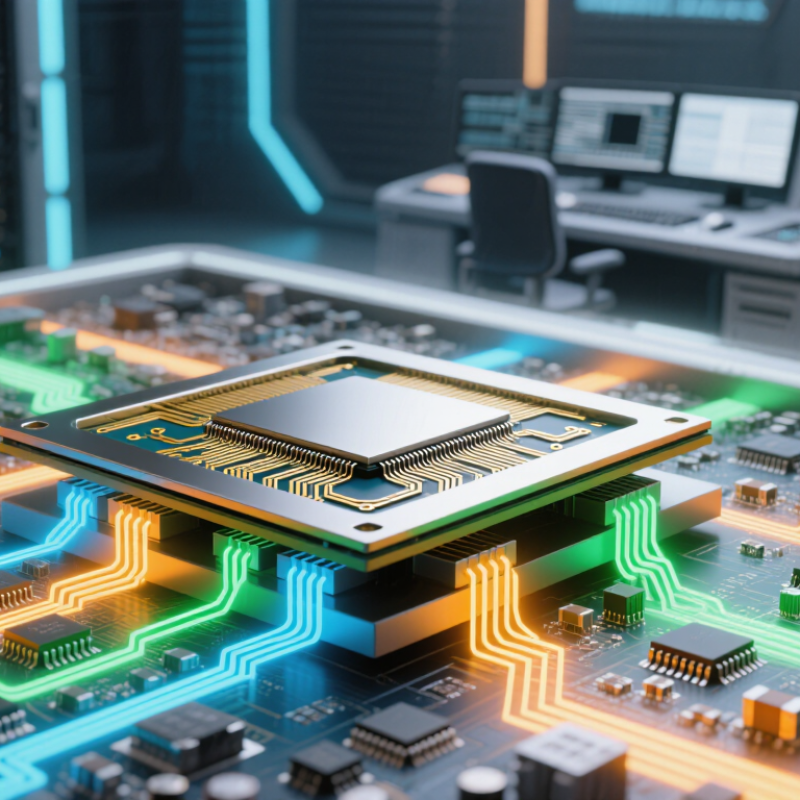
What an FPGA Chip Is and How It Works
An FPGA, or field-programmable gate array, is a chip whose internal logic can be configured after manufacturing. It contains programmable logic blocks, routing connections, and input/output resources. Unlike a general-purpose processor, it can be arranged to perform several operations in parallel. Think of it as a tiny configurable circuit board. The design still has limits: available logic, memory, and connection speed all matter.
A developer describes the desired hardware using a hardware description language. Design tools then map that description onto the chip’s logic blocks and connections. A configuration file, often called a bitstream, sets how those resources behave. Small lookup tables can implement logic functions, while flip-flops hold values between clock cycles. Once configured, the circuit runs directly in hardware. For example, separate blocks can process sensor readings while another manages data transfer. Timing can be tricky; a design that looks correct in code may miss its clock deadline.
Tips: Start with one measurable task, such as filtering a sensor signal. Check resource use and timing early; the first layout may need rethinking.

How Project Requirements Map to FPGA Capabilities
Why Choose an FPGA Chip for Your Project?
Project requirements should drive the choice of an FPGA, not the appeal of reconfigurable hardware alone. For streaming data, an FPGA can process samples through a tailored pipeline, such as filtering sensor readings as they arrive. That can support predictable latency and direct I/O. Latency matters. But performance depends on the design, clock rate, memory access, and available logic resources.
Power budgets also matter. A Lawrence Berkeley National Laboratory report for the U.S. Department of Energy estimated that U.S. data centers used 176 terawatt-hours of electricity in 2023, or about 4.4% of national use. It projects 325 to 580 terawatt-hours by 2028. This is not an FPGA efficiency guarantee; it highlights why teams should measure energy per task. Compare a working prototype under realistic workloads, not just a datasheet estimate.
Choose an FPGA when requirements include custom interfaces, parallel operations, or stable timing that general-purpose processors struggle to meet. For changing algorithms or frequent software updates, a CPU may be easier to maintain. FPGA development can demand hardware-design expertise, and tight resource limits can force compromises. Measure it. Map required throughput, response time, power, and update frequency to a test plan before committing. The DOE report’s wide projection range also reminds teams that estimates carry uncertainty.
Key Advantages of Using an FPGA
An FPGA is valuable when a project needs hardware that can change after deployment. Unlike a fixed-function chip, its logic can be reconfigured for new protocols, sensor formats, or control tasks. It can also process many operations in parallel, which helps in applications such as real-time vision, industrial control, and signal processing. That matters. A camera pipeline, for example, can handle several image operations in a predictable sequence without sending every frame through a general-purpose processor. The WSTS Fall 2024 forecast projected global semiconductor sales of $626 billion in 2024 and $697 billion in 2025. This broad market measure does not isolate FPGA demand, but it reflects the growing scale of semiconductor-based systems.
The practical advantages are adaptability, low-latency processing, and long product life. A design team can update logic in the field, rather than replace an entire board when requirements shift. Predictable timing is especially useful when milliseconds—or less—matter. There is a trade-off. FPGA development can demand specialized skills, careful verification, and more design time than a software-only approach. Power use and unit cost also depend heavily on the chosen device and workload. No magic here. A small prototype may reveal that a simpler processor is sufficient; teams should measure latency, power, and cost with their own data before committing. One easy mistake is treating reconfigurability as a benefit by itself. It matters only when the project truly needs it.
Why Choose an FPGA Chip for Your Project? - Key Advantages of Using an FPGA
| Advantage | What It Means | Project Benefit | Important Consideration |
|---|---|---|---|
| Hardware reconfigurability | The device’s logic can be configured after manufacturing and updated when requirements change. | Designs can be revised or extended without creating a new custom silicon device. | Configuration changes require compatible design tools, verification, and a suitable device. |
| Parallel processing | Multiple logic operations can run concurrently in dedicated hardware rather than being executed only as sequential instructions. | Useful for workloads with parallel tasks, such as digital signal processing, image pipelines, and data-stream handling. | Performance depends on the design, available resources, clock rate, and how well the workload can be parallelized. |
| Deterministic, low-latency response | Custom hardware pipelines can process data with predictable timing and avoid some operating-system scheduling delays. | Can suit real-time control, communications, and measurement systems with strict timing requirements. | End-to-end latency still depends on the complete system, including interfaces, memory, and software. |
| Customizable I/O and interfaces | Programmable logic can implement interface protocols and connect multiple signals in a design-specific way. | Enables integration with specialized sensors, converters, and legacy or custom interfaces. | Electrical standards, pin assignments, and supported interface speeds are limited by the selected device and board. |
| Rapid prototyping | Hardware behavior can be tested on a programmable device before committing to a fixed-function implementation. | Helps teams evaluate algorithms, interfaces, and system architecture using real hardware. | FPGA prototypes may differ from a final ASIC in timing, power, area, and implementation details. |
| Hardware acceleration | Compute-intensive functions can be implemented as dedicated circuits alongside a processor. | Can offload suitable tasks while keeping general-purpose control and application code on a processor. | Acceleration is not automatic; data movement and development effort can offset performance gains. |
| Long-term adaptability | Reprogrammability can allow deployed designs to receive functional updates, subject to system access and security controls. | Useful when standards, algorithms, or product requirements may evolve after deployment. | Updates need careful validation and secure configuration management, especially in safety-critical systems. |
| Development flexibility | Designers can combine configurable logic with device-specific resources such as embedded memory or dedicated arithmetic blocks, when available. | Supports a range of architectures, from custom data paths to processor-plus-accelerator systems. | Resource limits and design complexity must be assessed early; FPGA development can require specialized skills. |
Design and Cost Trade-Offs to Consider
An FPGA can reduce risk when a design is still changing, but flexibility has a price. Engineers can revise logic after fabrication, which helps when sensor formats or timing requirements shift. That does not make the board simple. A prototype handling a fast data stream may need careful clock-domain crossing, pin planning, and timing constraints before it behaves reliably. Small oversights matter. A minor constraint can turn a clean timing report into a late redesign.
Cost depends on production volume and engineering time, not just chip price. FPGA devices often cost more per unit than fixed-function alternatives, while avoiding a custom silicon development cycle. For a few hundred units, that trade may be sensible; at higher volumes, recurring device cost can dominate. Power and board area need measurement, too, since a larger device can increase both. Budget for development tools, verification, and engineers who understand synthesis and timing closure. These costs are easy to underestimate. I would compare a working prototype with a realistic production estimate, including spare capacity for future logic. Unused flexibility can become paid-for complexity when requirements stay stable.
When an FPGA Is the Right Choice for a Project
A n FPGA is a strong fit when a project needs parallel processing, predictable response times, or interfaces that may change after deployment. A machine-vision unit, for example, can process several sensor streams at once. A test instrument may support a new protocol without replacing its board. That flexibility has a cost. Engineers must verify timing, manage concurrent logic, and budget for power and cooling.
MarketsandMarkets’ 2024 FPGA market report projects growth from $12.1 billion in 2024 to $19.1 billion by 2029. That forecast signals demand, not proof that an FPGA suits every design. Consider one when requirements are clear enough to define, but algorithms or standards may evolve. It also fits low-latency pipelines where software scheduling adds too much variation. For a simple control loop, a microcontroller may be cheaper and easier to maintain. Tool-chain learning and verification time are easy to underestimate. I would prototype the hardest timing path first, then compare measured latency, power, and unit cost with alternatives. Not glamorous. It can prevent a costly redesign.
