
Why Are Industrial Valves Important for Your Business?
Industrial valves rarely attract attention when a plant runs smoothly. Yet they control the movement, pressure, and direction of fluids through essential equipment. A poorly selected valve can cause leakage, unstable flow, frequent maintenance, or costly downtime. The impact may begin with a small detail: a seat worn by abrasive fluid, or an actuator struggling to open.
Process-control engineer and handbook author Béla G. Lipták offers a useful perspective. Paraphrased from his process-control guidance: “A control valve must suit the process conditions it will actually face.” That means considering the fluid, temperature, pressure, flow range, and operating cycle—not just the pipe size. It is a practical reminder, not a shortcut to engineering review.
For a business, the right industrial valves can support safer operations, steadier product quality, and more predictable maintenance. They can also help reduce energy losses when selected and maintained appropriately. But there is no universal best valve. A design that performs well on clean water may struggle with a viscous or particle-filled medium. That deserves a second look during purchasing.
This guide explains where industrial valves matter, how selection affects operating costs, and what buyers should check before installation. It also considers inspection and maintenance, because even a well-chosen valve can fail when neglected. Real systems are imperfect. Good decisions start by understanding their actual conditions.
What Industrial Valves Do in Process Lines and Utility Networks
Why Are Industrial Valves Important for Your Business?
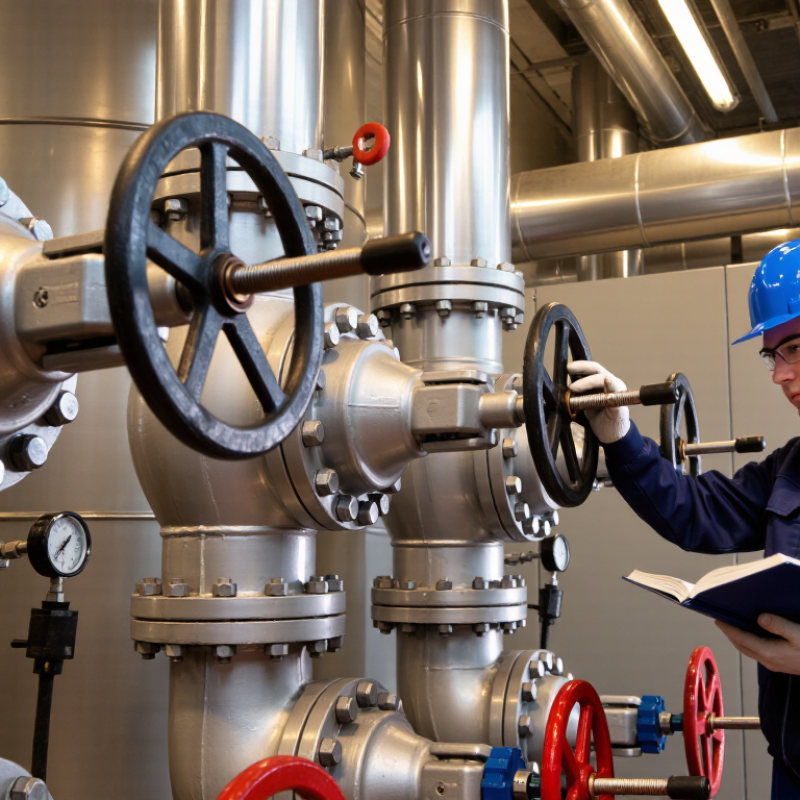
In process lines, valves direct, regulate, isolate, and sometimes prevent reverse flow. A control valve may trim steam or cooling-water flow as demand changes. An isolation valve lets technicians separate a pump or heat exchanger for maintenance. Check valves help limit backflow, while pressure-relief valves protect equipment when pressure rises beyond set limits. Small components. Big consequences.
Valve choices affect more than flow. The U.S. Department of Energy’s 2012 Improving Steam System Performance: A Sourcebook for Industry estimates that steam systems account for about 30% of energy used in industrial applications. In utility networks, a poorly selected or partly closed valve can add resistance and increase pumping demands. DOE’s Improving Pumping System Performance sourcebook reports that pumping systems use nearly 20% of global electricity. These figures do not mean every valve causes major losses, but they show why pressure drop and control strategy deserve attention.
Good practice starts with the service: fluid, temperature, pressure, required flow, and operating frequency. Engineers should check materials, actuator response, and maintenance access, then confirm performance under real operating conditions. A valve that works on a drawing may behave differently during startup. That detail is easy to miss. Routine inspections can reveal packing leaks, vibration, or a valve that no longer reaches its commanded position; records make recurring problems easier to spot.
Why Are Industrial Valves Important for Your Business? — What Industrial Valves Do in Process Lines and Utility Networks
| Valve Type | Primary Function | Typical Process-Line Use | Typical Utility-Network Use | Business Value | Key Selection Consideration |
|---|---|---|---|---|---|
| Gate valve | Starts or stops flow; generally intended for fully open or fully closed service. | Isolating pipelines carrying compatible liquids, gases, or steam. | Sectional isolation in water, fire-protection, and some steam networks. | Provides a relatively unobstructed flow path when fully open and helps isolate equipment for maintenance. | Not generally suited to throttling; check pressure, temperature, fluid compatibility, and required shutoff performance. |
| Globe valve | Regulates or throttles flow using a movable disc and seat. | Adjusting flow in process branches, cooling circuits, and steam services. | Controlling flow in utility branches where frequent adjustment is required. | Enables deliberate flow adjustment and can support more stable operating conditions. | Pressure drop is typically higher than in a fully open gate or ball valve; select for the required flow and control duty. |
| Ball valve | Provides quick shutoff, commonly with a quarter-turn operation. | On-off isolation for compatible process fluids and gases. | Isolation of compressed-air, water, and other utility branches. | Fast operation can reduce isolation time and simplify routine operation. | Confirm materials, seat design, temperature limits, and whether the application requires throttling or tight shutoff. |
| Butterfly valve | Controls or isolates flow with a rotating disc. | Large-diameter lines, including water and other compatible low-viscosity fluids. | Cooling-water, HVAC, and water-distribution networks. | Compact construction can reduce space and weight requirements, particularly on larger pipes. | Performance depends on size, pressure, disc and seat materials, and the required flow-control range. |
| Check valve | Allows flow in one direction and helps prevent reverse flow. | Downstream of pumps or in lines where backflow could disrupt equipment or process conditions. | Pump discharge lines and water systems where reverse flow needs to be limited. | Helps protect pumps and reduce the risk of backflow-related interruptions or damage. | Choose a design suited to flow velocity, installation orientation, pressure conditions, and the risk of water hammer. |
| Control valve | Modulates flow, pressure, temperature, or liquid level in response to a control signal. | Automated process loops that need continuous adjustment. | Regulating utility services such as steam, cooling water, or compressed air. | Supports consistent process conditions, product quality, and efficient use of utilities. | Size for the actual operating range and consider actuator, control signal, fluid properties, and fail-safe requirements. |
| Pressure-relief valve | Opens at a set pressure to relieve overpressure and protect equipment. | Protecting pressure vessels, boilers, and process equipment where overpressure is a credible hazard. | Protecting pressurized utility equipment and systems, as required by applicable design codes. | Provides a key layer of pressure protection when correctly selected, installed, and maintained. | Set pressure, capacity, discharge routing, fluid service, and applicable codes must be determined by qualified personnel. |
Note: Applications shown are common examples, not universal rules. Final valve selection depends on operating pressure and temperature, fluid properties, flow requirements, materials, applicable codes, and maintenance needs.
Related Posts
-
Ultimate Guide to Selecting the Right Industrial Valves for Your Applications
-
How to Choose the Right Metering Valve for Your Needs?
-
How to Choose the Right Industrial Valves for Your Manufacturing Needs
-
Essential Tips for Choosing the Right Isolation Valve?
-

Understanding the Mechanisms and Benefits of Ball Check Valves in Modern Applications
-

Ultimate Checklist for Choosing the Right PTFE Valve for Your Industrial Needs
